
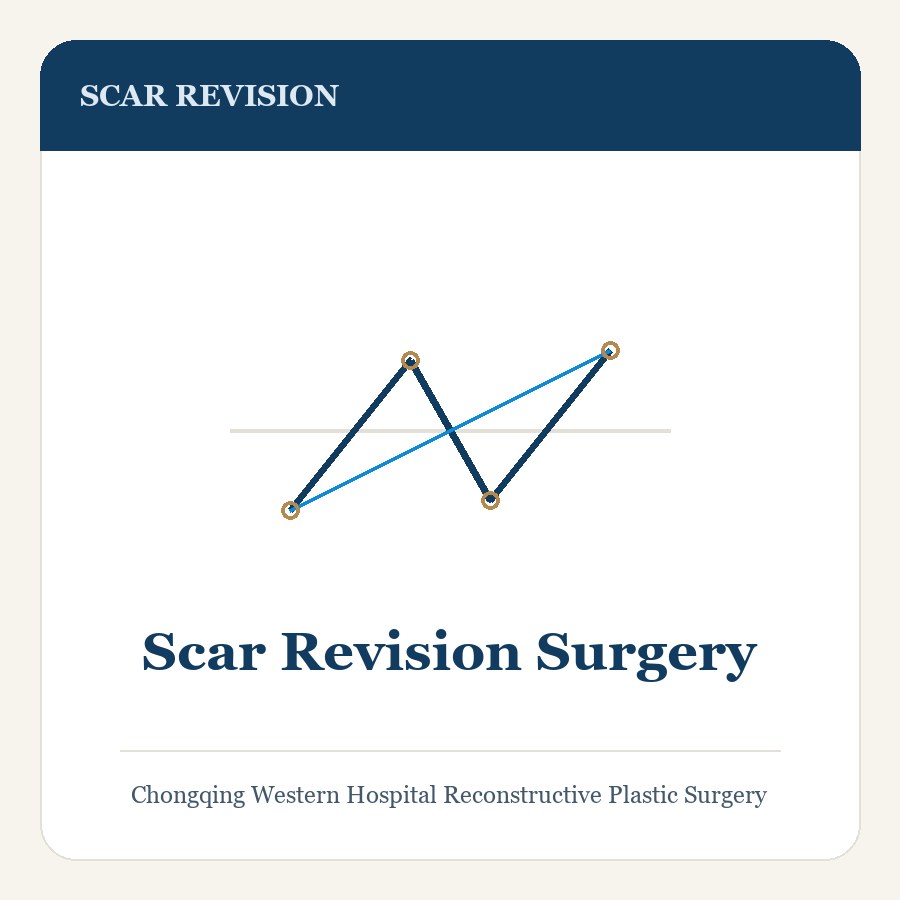
In short. Scar revision is surgery to improve a scar that is wide, raised, sunken, tight, poorly positioned or conspicuous. It cannot erase a scar: it exchanges one for a finer, flatter scar aligned with natural skin lines. Assessment of the scar's cause comes before any technique is chosen.
Key points
- A scar can never be erased; revision exchanges it for a finer, flatter scar.
- Mature scars at least six to twelve months old are the usual candidates.
- Z-plasty redirects a scar into natural creases and lengthens a contracted band.
- Active keloid disease, isotretinoin use and smoking defer surgery.
- Most good revisions still leave a fine permanent line.
What scar revision can and cannot change
Scar revision is surgery to improve a scar that is wide, raised, sunken, tight, poorly positioned or simply conspicuous. The honest starting point is that a scar can never be erased. It can only be exchanged for a better scar: finer, flatter, better aligned with natural skin lines, and less noticeable at conversational distance. That trade is often worth making, but it is a trade, not a removal. Revision can make a scar narrower, flatter, softer and better aligned, and it can release contractures that limit movement or distort features. It cannot guarantee invisibility or prevent recurrence in someone whose skin scars badly, and most good revisions still leave a fine permanent line.
Why scars disappoint, and why the cause decides the repair
Scars disappoint for identifiable reasons. Some healed under tension and stretched wide. Some crossed relaxed skin lines at a bad angle and catch the light. Some contracted and distort a lip, eyelid or joint. Some became hypertrophic: thick and raised within the original wound boundary. Each cause has a different surgical answer, which is why assessment comes before technique.
Who is a candidate, and when is surgery deferred?
The best candidates have a mature scar, usually at least six to twelve months old, that has stopped improving on its own, a specific complaint about it, and realistic expectations. Surgery is deferred for active keloid disease without a combined management plan, for isotretinoin users until cleared, and for smokers until they stop, because smoking measurably worsens wound healing.
Re-close, redirect, or break up
Excision and layered re-closure suits wide or sunken scars with enough loose skin nearby. Z-plasty uses two small transposed triangles to redirect a scar into natural creases and to lengthen a contracted band; it is standard for scars crossing joints or distorting features. W-plasty breaks a long straight scar into small irregular segments that the eye reads less easily. Sometimes the right answer is not surgery at all: laser, needling or pressure may improve texture and colour with less risk. The choice follows the scar, not fashion.
| Approach | What it does | When it fits | Limits |
|---|---|---|---|
| Excision and layered re-closure | Removes the old scar and closes the skin in layers | Wide or sunken scars with enough loose skin nearby | Cannot remove the scar or prevent recurrence |
| Z-plasty | Transposes two small triangular flaps to redirect the scar into natural creases | Scars crossing joints or distorting a lip or eyelid | Lengthens a contracted band but leaves a permanent line |
| W-plasty | Breaks a long straight scar into small irregular segments | A long straight scar that draws the eye | Does not remove the scar |
| Laser, needling or pressure | May improve texture and colour with less risk than surgery | When surgery is not the right answer | Does not remove the scar |
| Review while the scar matures | Waits until the scar has stopped improving | A scar that is still pink and changing | Operating too early usually wastes the operation |
Operative details and anaesthesia
Most scar revisions are day procedures under local anaesthesia, taking thirty minutes to two hours depending on length and technique. Fine layered closure with deep tension-absorbing sutures is what gives the new scar its best chance; the surface sutures come out early to avoid track marks.
Recovery, aftercare and the maturing scar
Sutures are removed at five to fourteen days depending on site. The new scar is red and firm for weeks, then matures over twelve to eighteen months. Sun protection, silicone gel or sheeting, and sometimes taping to offload tension are standard aftercare, and they genuinely change the final result.
What are the risks, and when is a second revision considered?
Risks include infection, wound separation, recurrence of widening or thickening, pigment change, and, in keloid-prone skin, a worse scar than before. A minority of scars benefit from a second refinement, planned no earlier than a year after the first.
When should a scar be reviewed before revision?
A scar that is still thickening, itching or spreading beyond the original wound suggests keloid behaviour and changes the whole plan. A scar that limits joint movement, pulls on an eyelid or lip, or ulcerates repeatedly needs review. So does a scar that is still pink and changing: operating too early usually wastes the operation.
Sources
- American Academy of Dermatology: patient information on scar treatment
- American Society of Plastic Surgeons: patient information on scar revision
- Cochrane Library: systematic reviews on scar management
Source links open each organisation's search results for the topic. Document-level confirmation is pending the reviewer's sign-off.
Internal links
Frequently asked questions
Can surgery remove a scar completely?
No. A scar can only be exchanged for a better one: finer, flatter, and better aligned with the natural skin lines so it is less noticeable at conversational distance. Most good revisions still leave a fine permanent line.
When is a scar ready to be revised?
Usually once it is mature, at least six to twelve months old, and has stopped improving on its own. Surgery is also deferred while keloid disease is active, while isotretinoin is still in use, and until smoking stops, because all three worsen healing.
What does a Z-plasty achieve that simple re-closure does not?
Z-plasty transposes two small triangular flaps to redirect a scar into natural creases and to lengthen a contracted band. It is the standard answer for scars crossing a joint or pulling on a lip or eyelid, where re-closing along the same line would tighten things further.
Risks & Limitations
- Reconstruction is usually staged — more than one operation is normal, and the plan may change as healing progresses.
- Donor-site scarring and discomfort, including after rib cartilage harvest.
- Partial or complete failure of a flap or graft, which may require further surgery.
- Scars are permanent. They mature and fade but never disappear.
- Asymmetry and the inherent limits of matching a normal side.
- Altered sensation, numbness or weakness in the operated area.
- Contracture, which may need release procedures later.
- Final assessment is made at 6–12 months, and longer in growing children.
When to Seek Care
- A flap or graft that turns dark, cold, black or stops bleeding when pricked.
- Fever above 38 °C, or spreading redness, warmth or discharge around a wound.
- New or worsening pain, swelling or fluid leakage from the operative site.
- Bleeding that does not stop with gentle pressure.
- Any change in a reconstructed area that concerns you, however minor.
References & Further Reading
- American Society of Plastic Surgeons (ASPS) — reconstructive surgery guidance
- World Health Organization (WHO) — burn and trauma care resources
- Chinese Medical Association, Plastic Surgery Branch — clinical guidance
- Cochrane Library — systematic reviews in wound and reconstructive care
This page is patient education, not medical advice, and it does not cite individual studies. Discuss your own case with a qualified clinician. To arrange an assessment at Chongqing West District Hospital, see Contact & Consultation.